
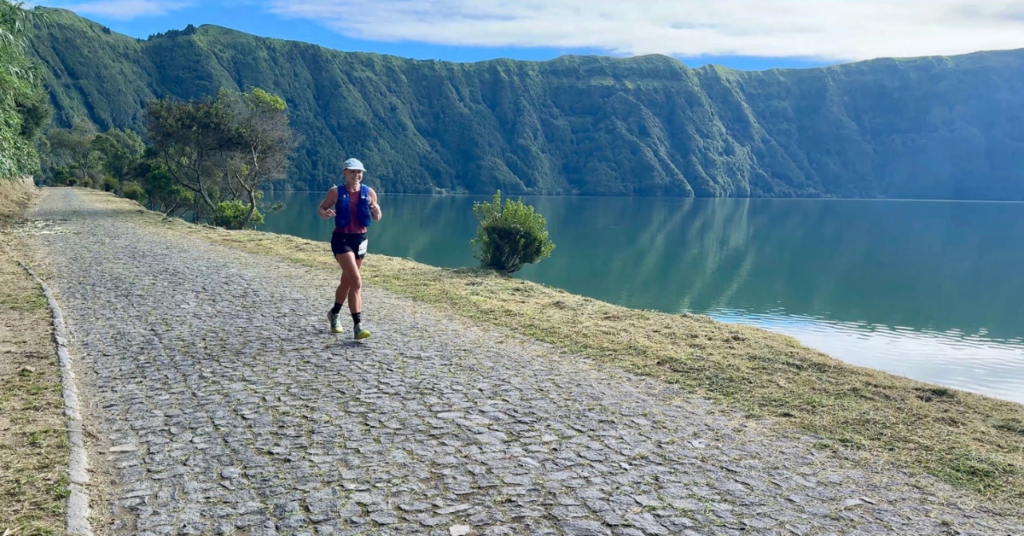
This was my second 50k distance.
I had never heard of the Azores before discovering this race, but when I learned it was on a dormant volcanic island, and that the race route took you around about half of the island—including views of the “lagoons” at the top of the volcano—I was in.
It was the perfect race to sign my husband and me up for to celebrate 20 years of marriage this September.
Interestingly, when we got married, neither of us were runners. Neither of us were really in any sort of shape, other than what 20-year-olds attain naturally. But five years ago, we picked up the habit. Now we run regularly, mostly half-marathon distances, with one ultra under our belts at this point.
Fast forward to the lead-up to the Ultra.
Training was a bit depressing this summer. We both developed injuries (welcome to your 40s!).
Mine was minor posterior tibialis tendonitis, which affected my ankle and foot. It developed when I started doing some more intense speedwork, as one of my goals had been to run a faster half marathon. I hadn’t managed that yet this year, although I had tried, running two.
Unfortunately, the injury took me out for a week, during which I biked instead. When I came back to running, it was without the speedwork.
That week off made me realize my only real goal at this point was to be able to KEEP running long-term—and to do the Ultra I had signed up for in September. I didn’t care if I was fast.
My husband developed some hip tendonitis and possible bursitis. Ironically, his physiotherapist thought it was more likely from golf than running. So he had to take about a month off training. He was a very good physio patient and did exactly what he was told.
About a week before the race, I realized I was potentially the LEAST prepared I had ever been for a race.
I had much less mileage compared with my Ultra last year. I had been taking a more conservative approach in my training, incorporating several bike rides per week, with my longest run being 2½ hours, or around 23–25k.
My main assurance was that my body was overall strong—including my legs, which I now affectionately call my “ultra legs.”
They used to be scrawny little sticks, not strong at all, until I started running and especially when I started Ultra training. Now these legs can hike for days, so I was confident that even if I couldn’t run, I could hike. Pending the foot pain didn’t crop up.
So we arrived in São Miguel, Portugal, and took in the sights of the island. It was beautiful, and unlike anywhere I’d been before.
Now I was getting excited to start the race.
We took a drive up to the lakes we’d soon be running around—Sete Cidades—and realized we were not only physically unprepared, but gear unprepared as well.
The rain came down heavily and the fog was thick. We immediately went to Decathlon afterward and bought proper raincoats—not something we had even packed.
Hiking poles would also have been handy, but I’d heard they need practice in training before racing with them, so that was out of the question.
Race day came, and we took our place at the very back of the 40 people—mostly fit Portuguese men.
We told the race director, who would be taking up the rear to keep an eye on things, that we would be taking it pretty slow. He assured us that was fine and that we should just enjoy ourselves. He also said the nine-hour cutoff would be more than enough time.
I found this humorous, considering our last ultra had taken exactly 9 hours and 4 minutes, with less elevation and a course two kilometres shorter.
I chuckled when he said it, wondering about the type of athletes who normally embark on this race.
How out of our league were we anyway?
My only hope was that the race was less technical than Newfoundland—fewer roots, rocks and stumps to watch out for.
Which, thankfully, it turned out to be.
We set out and enjoyed the first seven kilometres of rolling hills, similar to what we run back on PEI.
Then the first big climb came, where we took on about 540 metres of elevation. It brought us to the top of our first lookout over the lake, along with the first aid station.
I was in awe.
On one side of me was the beautiful crater-filled lagoon, and on the exact opposite side, the wide-open Atlantic Ocean.
It was exactly why we signed up for this race.
The skies were clear, thankfully, and the sun was shining brightly, allowing us to see the full view.
This would later, of course, become more of a burden than a delight—but we were happy for it at that moment.
We ran around these beautiful craters, then down into a dark woods with tall, perfectly straight trees.
Descending about half of what we had climbed, we were careful not to run it too quickly and burn out our quads. Descending is always harder on the body than ascending.
Then we came to our second “experience,” I’ll call it.
The tunnel.
Quick flashback to me at the start of the race, quizzically holding a headlamp and wondering why we would need one when the race was happening in full daylight.
I set it down on a picnic table because I didn’t want to carry the extra weight of it—it was also dollar-store quality—for the 50k I was about to run.
Now it all made sense.
Thankfully, my rule-abiding husband led his rebellious wife through the tunnel with his cheaply made headlamp. I turned on my cellphone flashlight, which honestly was better anyway.
The tunnel was a little over a kilometre long, and the running path was full of water. So we straddled the hydraulic pipes and shuffled our way through, bent over so our heads wouldn’t touch the top of this 100-year-old shaft.
It dawned on me that this was why the race was called “Trail of the Bats.”
Thankfully, no bats were found by us!
We exited the tunnel with dry feet and sucked in the fresh air.
The next part would have to be one of my favourite portions of the race.
Running under the mountain had led us to the base of the beautiful lake that we had seen from above some seven kilometres earlier.
Two lakes, actually: a blue lagoon and a green lagoon.
We ran on flat cobblestone streets through a beautiful, nearly empty village, across a beautiful old bridge and onto our second aid station.
I tried some Coca-Cola at this aid station, which I hate the taste of, but soon realized why it’s a favourite among ultra runners.
The mix of high sugar and caffeine really hit the spot!
We took off again into our biggest climb, which thankfully was spread out over about eight kilometres, so it didn’t feel brutal.
We reached the highest point of our adventure at 873 metres.
This section had some of the most beautiful views, looking out over the third lagoon and running through the highlands of the island.
It was the busiest part of the race as well, rubbing shoulders with many hiking tourists, who all seemed to be going in the opposite direction, thankfully.
We were all on a narrow path, so our main concern was not knocking anyone over while we ran cautiously through.
Some people looked confused as to why anyone would run here—the footing wasn’t ideal, and also, the views were spectacular, so why rush? Others cheered us on and gave encouraging words.
Once out of this area, we went back onto secluded private property and farmers’ fields.
The beauty continued.
Hydrangea-filled ditches and wide-open pastures with cows grazing, probably also wondering why there were strange people running through their ocean-view fields.
We had to step carefully here as well, but for different reasons. 😉
Body check-in: at this point, we were both still feeling good.
We’d taken some Tylenol to keep the sore knees at bay, and it was really helping. Neither of our injuries was an issue either.
We had discussed what we would do if one of us couldn’t continue, more likely to be John since his hip issue had been more severe.
Our game plan was to run it together, and if John had to bow out, I would go on without him.
So far, so good.
Meanwhile, we were listening to a pretty comical book about running—Ultramarathon Man by Dean Karnazes.
He was describing some of his ridiculous all-night runs, and one in particular had me laughing as he described going through a takeout line in the middle of the night on foot, buying copious amounts of food and convincing the person in the car behind him to pick it up for him because he wasn’t allowed to use the drive-through without a car.
It made me feel a little less nuts for being a 40-year-old woman climbing under electric fences to run through a foreign cow field, and squatting to pee on the side of the road every so often.
Up until about 40 kilometres, we were feeling great.
Then…the final 12k.
The sun was really beating down on us by this point in the mid-afternoon.
I thought back to the heat training that I had skipped leading up to the race, not realizing how much it would have helped me.
It was hotter than the weather forecast had predicted.
But it wasn’t only the heat.
Then came the third dreaded climb.
Whereas the others had been more spread out, this was a direct switchback up the side of a cliff.
We went from sea level to 280 metres in one kilometre.
At this stage in the race, with heat now a factor, fuelling and water running low, and legs that had already put in a great deal of effort, the climb felt like an insult.
To put things in perspective, a lot of my PEI training runs barely cover this amount of elevation over the course of 20k.
I have to actively HUNT for hills to get this kind of elevation.
But no. Here we were, climbing directly up the side of the island’s cliff overlooking the ocean—in the direct heat and sun.
I didn’t care about the view at all at this point.
I was mainly concerned about my husband, who was very red and looked like he might pass out any minute. Killing him was not, in fact, my ulterior motive for this 20-year anniversary ultra endeavour.
He doesn’t deal well with heat, and he was almost out of water.
I shared mine with him and got him to cool himself down by pouring it over his head. We both did this as we made that climb, seeking precious shade and resting whenever we could find it.
That one kilometre ended up taking us 25 minutes.
When we got to the top, I shared my final gel with John and we put on some motivating music. Both gave us some renewed energy.
At this point, we simply wanted to make it to the next aid station, one step at a time.
We managed to run some of it, but John was still recovering from the climb and the heat.
At the final aid station, out of the blue, I was passed by someone! A woman who appeared to be in her early 50’s.
I had thought she was long gone behind us—there were only two runners behind us—but she must have gained on us during the gruesome climb.
This was exactly the fuel I needed.
I was not going to let her beat me.
Yes, some competition helps one perform better.
It was the gas in my tank to run faster.
John knew this, and also knew he was holding me back, so he encouraged me to go on ahead.
We have a mutual understanding when we race. I was the one who held him back on our last ultra…we tend to take turns.
So I took off to catch her, only to discover yet another torturous descent down toward the ocean, followed immediately by a 170-metre climb back up a cement horse-path hill.
But with the woman right in front of me, I knew I had it in me to finish strong.
I kept her just ahead of me, then passed her on the way back up the hill. I’ve realized one of my strengths in running is climbing. (Remember my ultra legs?)
Then a race organizer at the top said, “Only 30 minutes left—start running.”
I was irritated by his comment. I had just summited the hottest climb after a 49k effort, so being told to “start running” was a real flame-stoker.
Yet I understood his job. It’s actually a lot like my own. Encouraging people along when they are at their hardest point is something I know well.
So as annoyed as I felt, I understood.
And I did start running!
John had rallied by now and caught up to me again, and we finished the final two kilometres into town toward the finish line together.
I felt exhausted but strong, and I noted that if the race had been another 5k, I could have kept going. I still had some gas.
But I was happy to be done!
We entered the finishing tunnel together and received our medals, giving tired high fives to the Portuguese cheering us on—with only 20 minutes to spare before the race cutoff.
It was exactly the kind of race I wanted.
Something to challenge me mentally and physically.
We took shade under the tents, and to my surprise, I was handed a trophy for second female 40+.
I smirked to myself.
Sure, second…but also last female 40+.
That’s what happens when the race sign-up is small!
The only other woman in the 40+ category, also placed first female finisher—and fifth overall.
I had met her at bib pickup the day before. I knew it when I saw her: she was a digger.
I love racing against awesome women, and it doesn’t matter how they place. They showed up and chose something hard over comfort. Every one of them was an inspiration to me. Some of these women I found out later, are their 6th ultra distance this year alone, including 100 milers!
That evening, as we went to bed, I said to John, “I don’t want to do something like that again for a long time.”
He smiled, knowing his wife of 20 years well enough to know it wasn’t true.
And sure enough, something happened that night while I slept.
Call it recovery…call it crazy.
But the next day I was researching my next race options.
Some of you might be wondering ‘why’?
I wonder about this too, and it’s a hard question to answer.
One of the closest explanations I came across was in a book I read the following week, The Way of Excellence, in a chapter called “Curiosity.”
Curiosity, he explains, is integral to growth.
When Kobe Bryant was asked whether he played basketball because he loved to win or hated to lose, his response was neither. He played to figure things out—to learn something.
That idea stuck with me.
My nature has always leaned toward curiosity and inquisitiveness. I don’t typically accept a pat answer until I understand the “why” and the “how” behind it. I like to test things and explore.
I also love being present, and I especially feel an ability to do that in nature.
Maybe I run because I’m curious—both about the environment around me and about discovering my own limits.
Running gives me a way to explore both.
And maybe that’s why these challenges keep pulling me back: they show me something I didn’t know before and take me places I’ve never been.